Tuesday, October 27, 2015


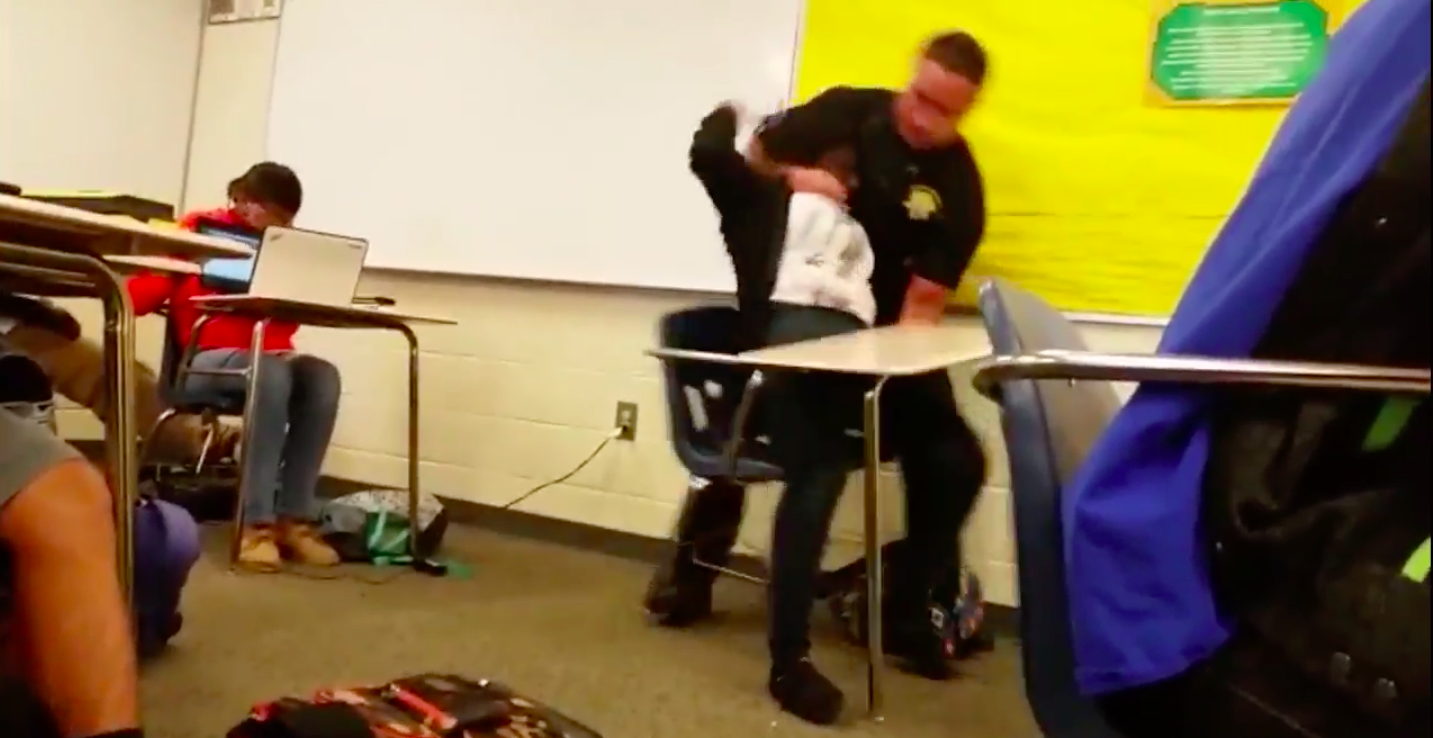
(www.BlackParents.org) - A South Carolina student was brutally attacked in class by a racist White school police officer, tossed across the room and arrested. The cop's criminal act was caught on video.

The officer, Deputy Ben Fields, has been suspended without pay during an internal investigation into the viral fracas, which drew condemnation from the likes of presidential candidate Hillary Clinton and the Rev. Jesse Jackson.
The FBI also opened a civil rights investigation into the brutal body-slamming of the black South Carolina high school student by a white sheriff’s deputy.

Robinson admits that although the girl did not give up her phone, she did apologize to the teacher and appeared remorseful. However, Mr. Long called the officer to his classroom to remove the girl from the room.

Tony admits that upon seeing the deputy move the victim’s items off her desk, while also asking for another student move their desk away from the victim, Tony said he immediately sensed something was wrong and pulled out his phone to record the incident:

 “When I saw what was about to happen my immediate first thing to think is let me get this on camera. This is going to be something that not only I’m going to be like ‘wow did this really happened at my class,’ but just something that everybody else needs to see. This is something that we can’t let this just pass by. [Officer Fields] asked her again, ‘Will you move, will you move.?’ She said, ‘No I have not done anything wrong.’ Then he said, ‘I’m going to treat you fairly. And she said ‘I don’t even know who you are.. And that is where it started right there. “I’ve never seen anything so nasty looking, so sick to the point that you know, other students are turning away, don’t know what to do, and are just scared for their lives. That’s supposed to be somebody that’s going to protect us. Not somebody that we need to be scare off, or afraid. That was wrong. There was no justifiable reason for why he did that to that girl.”


Monday, October 5, 2015


(www.BlackParents.org) - A 10-year-old African-American girl living in Kenner, Louisiana who has been diagnosed with autism, had an outburst in class. She jumped out of a window and climbed a tree. Instead of ensuring that the school had the appropriate special needs professionals on staff to help students, the school called the police. Five  Whitepolice officers tackled the special needs child and  hand cuffed her.


In their zeal to crack down on guns and lock down the schools, these cheerleaders for police state tactics in the schools might also fail to mention the lucrative, multi-million dollar deals being cut with military contractors such as Taser International to equip these school cops with tasers, tanks, rifles and $100,000 shooting detection systems.

Indeed, the transformation of hometown police departments into extensions of the military has been mirrored in the public schools, where school police have been gifted with high-powered M16 rifles, MRAP armored vehicles, grenade launchers, and other military gear. One Texas school district even boasts its own 12-member SWAT team.


An American Psychological Association study found that black boys are perceived as older and less innocent than their white peers, and some studies indicate teachers can suffer from the fundamental attribution error, attributing minority children’s misbehavior to different causes than they do white children’s. Ramey notes how one study found that schools blame “poor parenting, cultural deficiencies, and poor character” for bad behavior among racial minority children, and see that behavior as permanent and leading almost inexorably to involvement with the criminal justice system. Further, a study on enrollment in special education programs found that “teachers and administrators are less likely to attribute minority students’ misbehavior to underlying behavior disorders,” which could be ameliorated with mental-health treatment.

If your child is fortunate enough to survive his encounter with the public schools, you should count yourself fortunate.


Most students are not so lucky.

By the time the average young person in America finishes their public school education, nearly one out of every three of them will have been arrested.
More than 3 million students are suspended or expelled from schools every year, often for minor misbehavior, such as “disruptive behavior” or “insubordination.” Black students are three times more likely than white students to face suspension and expulsion.

For instance, a Virginia sixth grader, the son of two school teachers and a member of the school’s gifted program, was suspended for a year after school officials found a leaf (likely a maple leaf) in his backpack that they suspected was marijuana. Despite the fact that the leaf in question was not marijuana (a fact that officials knew almost immediately), the 11-year-old was still kicked out of school, charged with marijuana possession in juvenile court, enrolled in an alternative school away from his friends, subjected to twice-daily searches for drugs, and forced to be evaluated for substance abuse problems.

As the Washington Post warns: “It doesn’t matter if your son or daughter brings a real pot leaf to school, or if he brings something that looks like a pot leaf—okra, tomato, maple, buckeye, etc. If your kid calls it marijuana as a joke, or if another kid thinks it might be marijuana, that's grounds for expulsion.”

Acts of kindness, concern or basic manners can also result in suspensions. One 13-year-old was given detention for exposing the school to “liability” by sharing his lunch with a hungry friend. A third grader was suspended for shaving her head in sympathy for a friend who had lost her hair to chemotherapy. And then there was the high school senior who was suspended for saying “bless you” after a fellow classmate sneezed.

Making matters worse are the police.
Students accused of being disorderly or noncompliant have a difficult enough time navigating the bureaucracy of school boards, but when you bring the police into the picture, after-school detention and visits to the principal’s office are transformed into punishments such as misdemeanor tickets, juvenile court, handcuffs, tasers and even prison terms.


In the absence of school-appropriate guidelines, police are more and more “stepping in to deal with minor rulebreaking—sagging pants, disrespectful comments, brief physical skirmishes. What previously might have resulted in a detention or a visit to the principal’s office was replaced with excruciating pain and temporary blindness, often followed by a trip to the courthouse.”


Thanks to a combination of media hype, political pandering and financial incentives, the use of armed police officers to patrol school hallways has risen dramatically in the years since the Columbine school shooting (nearly 20,000 by 2003). Funded by the U.S. Department of Justice, these school resource officers (SROs) have become de facto wardens in the elementary, middle and high schools, doling out their own brand of justice to the so-called “criminals” in their midst with the help of tasers, pepperspray, batons and brute force.


Sunday, October 4, 2015


The Internet is in an uproar over news that a12-year-old African American boy was suspended from school after he allegedly “stared” at a white girl in Glendale, Ohio.

“My son stared at a girl who was engaged in a staring game,” explained Candice Tolbert, the boy’s mother. “She giggled the entire time.”

The incident was decided recently in court regarding an event that occured in September, 2014.

The ‘staring contest’ occurred on Monday and the school was notified of the ‘problem’ by the girl’s parents on Tuesday. That day, the school talked to the boy involved but did not tell his parents until Wednesday, after he had already written an apology letter to the girl.

“I never knew she was scared because she was laughing,” he wrote. He also added, “I understand I done the wrong thing that will never happen again. I will start to think before I do so I am not in this situation.”

The boy is Black, and the girl is white, but the parents said they are not yet willing to say race played a role in their son’s suspension.  However, they did take action against the school.

The Tolberts filed suit in Hamilton County Common Pleas and charged that the school did not give their son due process. However, a judge denied their claim, and their son’s suspension remains standing.

According to a statement from the Archdiocese of Cincinnati:
Judge Patrick Dinkelacker listened to the plaintiff’s arguments yesterday, rejected them, and